


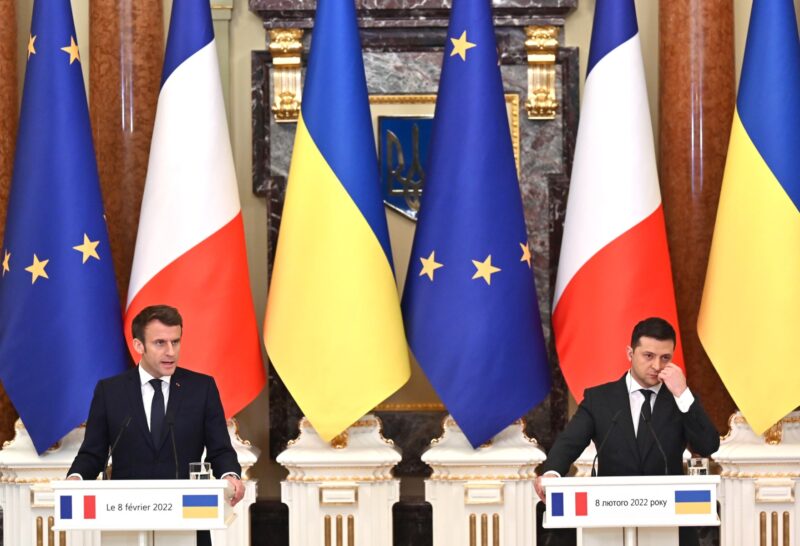
French President Emmanuel Macron has kept diplomacy on track in the crisis between Russia and Ukraine, even if his policy of a “demanding dialogue” with Russia has not met with universal support among Western allies.
With his two-day sequence of visits to Moscow, Kyiv and Berlin, Macron managed to put Europe back at the centre of resolving the crisis, though the threat of war remains real.
German Chancellor Olaf Scholz, who has insisted he is in lockstep with Macron in the crisis, will continue the diplomacy push by travelling to Kyiv and then Moscow –- notably the reverse order to the French president –- next week.
“We have simple objectives. Firstly to avoid war. The peace and stability of the European continent are our treasure and we consider it our duty to do everything to preserve it,” Macron said alongside Scholz and Polish President Andrzej Duda in Berlin, on the final leg of his trip late Tuesday.
– Not a ‘bluff’ –
But the likelihood of a new attack by Russia on Ukraine is far from being eliminated, with the French president struggling to balance the West’s defence of Ukrainian sovereignty with the security demands put forward by Moscow.
Russia has amassed some 130,000 troops close to the border with Ukraine as it seeks a guarantee that its neighbour will never join NATO along with US pledges over its military presence in eastern Europe, raising fears of a full-scale invasion.
“Russia’s buildup does not look like a bluff,” said Nigel Gould-Davies, a senior fellow at the International Institute for Strategic Studies (IISS).
“Unless they (Macron and Scholz), or parallel US efforts, shift the parameters, military conflict increasingly looks the most likely outcome of this crisis,” he said.
– ‘Against your will’ –
Adding to the complexities, Macron will soon have to throw himself into campaigning for France’s presidential elections starting April 10.
And to add to the foreign policy headaches, he also must decide whether to extract French troops from the anti-jihadist fight in Mali after a breakdown in relations with the ruling junta.
Macron held five hours of talks with Putin at the Kremlin on Monday, emerging without any breakthrough — the gigantic table they sat at symbolising the distance between Russia and the West and spawning a myriad of internet memes.
Putin’s comments after their talks were marked by chilling warnings, with the Russian leader saying that if Ukraine joined NATO and sought to take back the annexed peninsula of Crimea, Europe would “automatically” find itself in a military conflict with Russia.
Emphasising that Russia is a leading nuclear power and ahead of the West in some areas of military technology, he added: “There will be no winners, and you will find yourself drawn into this conflict against your will.”
– European ‘resilience’? –
A pan-European poll published Wednesday by the European Council on Foreign Relations (ECFR) showed that a majority of people in six of seven major EU countries –- the exception being non-NATO member Finland –- believed a Russian invasion of Ukraine was likely.
“The next few weeks will test whether Europeans can make the transition from a world shaped by soft power to one shaped by resilience,” said the report’s authors Ivan Krastev and Mark Leonard.
Macron and fellow EU leaders may also have to deal with trans-Atlantic splits, with not just Germany but also France failing to back a vow by US President Joe Biden to end the controversial Nord Stream 2 gas pipeline from Russia to Europe if Russia invades.
“Europeans have different interests from those of the Americans and we must be able to tell our American this allies in the most clear way,” French Economy Minister Bruno Le Maire said Tuesday.
He said if a conflict broke out, the US would not “endure the same consequences as the Europeans” notably in terms of European energy dependence on Russia.
– ‘Unsolvable equation’ –
Macron claimed he had won a commitment from Putin for no further escalation, but while he has made clear Russia’s demands over security should be heard — “showing respect for Russia and showing understanding for its traumas” — his options are limited.
After remarks on his flight to Moscow sparked controversy, Macron denied ever using the term “Finlandisation” as a possible option for Ukraine –- referring to the neutrality of the Nordic country in the Cold War –- which had sparked anger among some Western commentators.
“Old terms for new situations rarely work. @EmmanuelMacron,” seethed the former Finnish prime minister Alexander Stubb on Twitter.
The headline in the Le Monde daily Wednesday concluded: “The place of Ukraine in NATO –- Emmanuel Macron’s unsolvable equation.”













Discussion about this post